
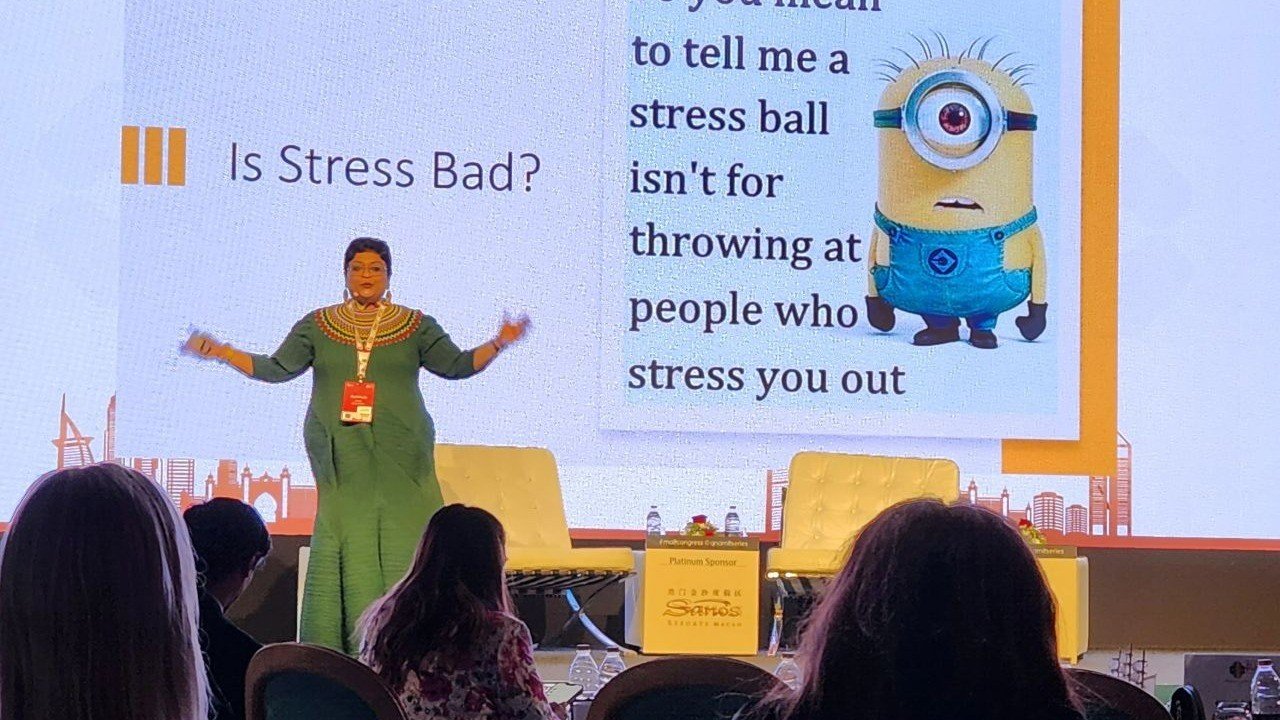
Last week, a senior leader said something to me that stayed with me.
“I would rather handle a board crisis than stand on a stage for 20 minutes.”
And he wasn’t joking.
If you’ve ever felt your heart race at the thought of speaking in front of a room, you’re not alone. In fact, some of the most capable leaders quietly avoid panels, decline keynote invitations, or delegate presentations, not because they lack ideas, but because something inside them tightens the moment they imagine the spotlight.
Not a capability gap. A visibility gap.
And underneath it, almost always, is not a content problem.
It is a courage and nervous system problem.
Why smart leaders freeze on stage
Most leaders are not afraid of speaking.
They are afraid of what comes with being seen:
- Being judged by peers or senior stakeholders
- Going blank in front of an audience
- Not sounding “sharp enough” or “senior enough”
On stage, something subtle happens. The brain stops treating it as communication and starts treating it as threat.
And when the nervous system senses threat, it does exactly what it is designed to do:
It protects you by pushing you to avoid it.
The cost of staying off the stage
The irony is that avoidance rarely protects your career. It quietly limits it.
Because:
- Visibility, not just competence, drives opportunity
- Your ideas stay trapped in rooms instead of shaping wider conversations
- Others begin representing your thinking in your absence
Leadership today is no longer confined to decisions behind closed doors.
It is also defined by how you show up in public spaces, town halls, conferences, webinars, and conversations that shape perception at scale.
When you step back from those spaces, your voice doesn’t disappear. It simply gets replaced.
Start small, but start
The most common mistake leaders make is believing they need to “fix” stage fear before they begin speaking.
It doesn’t work that way.
Confidence is not a prerequisite. It is a result of exposure.
Start small:
- A short update in a town hall instead of avoiding it
- A small panel before a large keynote
- A webinar before a conference stage
You don’t begin with mastery. You begin with movement.
Three gentle steps out of stage fear
1. Lower the bar on purpose
Shift the goal from “I must impress” to “I must be useful.”
When your intention changes from performance to contribution, your nervous system relaxes. Clarity returns when ego pressure reduces.
2. Train your nervous system, not just your slides
Most leaders rehearse content. Few rehearse discomfort.
Practice:
- Pausing mid-sentence and continuing calmly
- Saying “Let me rephrase that” without self-judgment
- Holding silence for 2–3 seconds after key points
Confidence is not built in perfect runs. It is built in imperfect moments that didn’t break you.
3. Start with safer stages
Confidence is built through exposure, not theory.
Begin with:
- Internal team meetings or town halls
- Small panels with shared speaking time
- Webinars or podcasts with structured questions
Safety first. Then scale.
A reframe that changes everything
One shift can change how you experience every stage:
The stage is not where I am judged. The stage is where I serve.
When your focus moves from self-image to service, something powerful happens.
Fear doesn’t disappear. But it loses authority.
Because contribution is always bigger than discomfort.
The real truth about executive speaking
Here’s something most leaders underestimate:
Executive speaking is not an inborn talent. It is an acquired skill. Anyone can learn it at any time.
In today’s world, your ideas are not enough.
How you communicate them determines how far they travel.
If this is you…
If you’ve been quietly avoiding speaking opportunities because the fear feels too real, pause here for a moment.
There is nothing wrong with you. Your response is human, not personal.
But it is also not permanent. This is a skill. And like every leadership skill, it can be built.You don’t need to start big. You just need to start small.
If you’d like support to move from hesitation to confidence on stage, contact me.
Neetu Choudhary
Business & Leadership Coach & Trainer| Board Member | Board Advisor | Keynote Speaker | Executive Speaking Coach | Business & Leadership Podcast “Lead With Neetu” |



Leave A Comment